1. Drastically Lower Energy Bills and Rapid Return on Investment
For homeowners across Southeast Michigan, energy costs represent a substantial and steadily growing portion of monthly household expenses. With regional utility rates climbing, uninsulated or under-insulated attics act as massive thermal leaks that continuously drain household budgets. Upgrading your attic thermal envelope is widely recognized by building scientists as the single most cost-effective home improvement project you can undertake.
When conditioned air escapes into an under-insulated attic, your heating and cooling equipment must run longer cycles to replace that lost energy. By establishing a continuous thermal barrier and sealing hidden air bypasses, homeowners experience an immediate reduction in HVAC workload. According to data from the Well-Insulated and Sealed Attic | ENERGY STAR program, air sealing and insulating attics delivers an average savings of 15% on heating and cooling expenses, which translates to roughly 11% off total home energy bills.
In our local climate—where sub-freezing winter temperatures transition quickly into humid, 90-degree summer heat waves—the actual savings are often even higher.
2. Superior Indoor Temperature Consistency and Extended HVAC Lifespan
Beyond financial returns, living comfort is the benefit homeowners appreciate most on a day-to-day basis. In an improperly insulated home, your indoor heat escapes directly upward through the ceiling plane in the winter. This process—driven by the “stack effect”—draws cold outdoor air into your living spaces through lower-level windows, doors, and foundation sills, resulting in persistent floor-level drafts and uncomfortably chilly rooms.
During Michigan summers, the dynamic reverses. Solar radiation heats roof shingles, driving attic temperatures upward of 130°F to 140°F. Without an adequate thermal defense, that intense heat radiates downward through the drywall of your upper ceilings. This creates the classic “two-story home dilemma,” where the second-floor bedrooms remain stiflingly hot and stuffy regardless of how low you set the air conditioning.
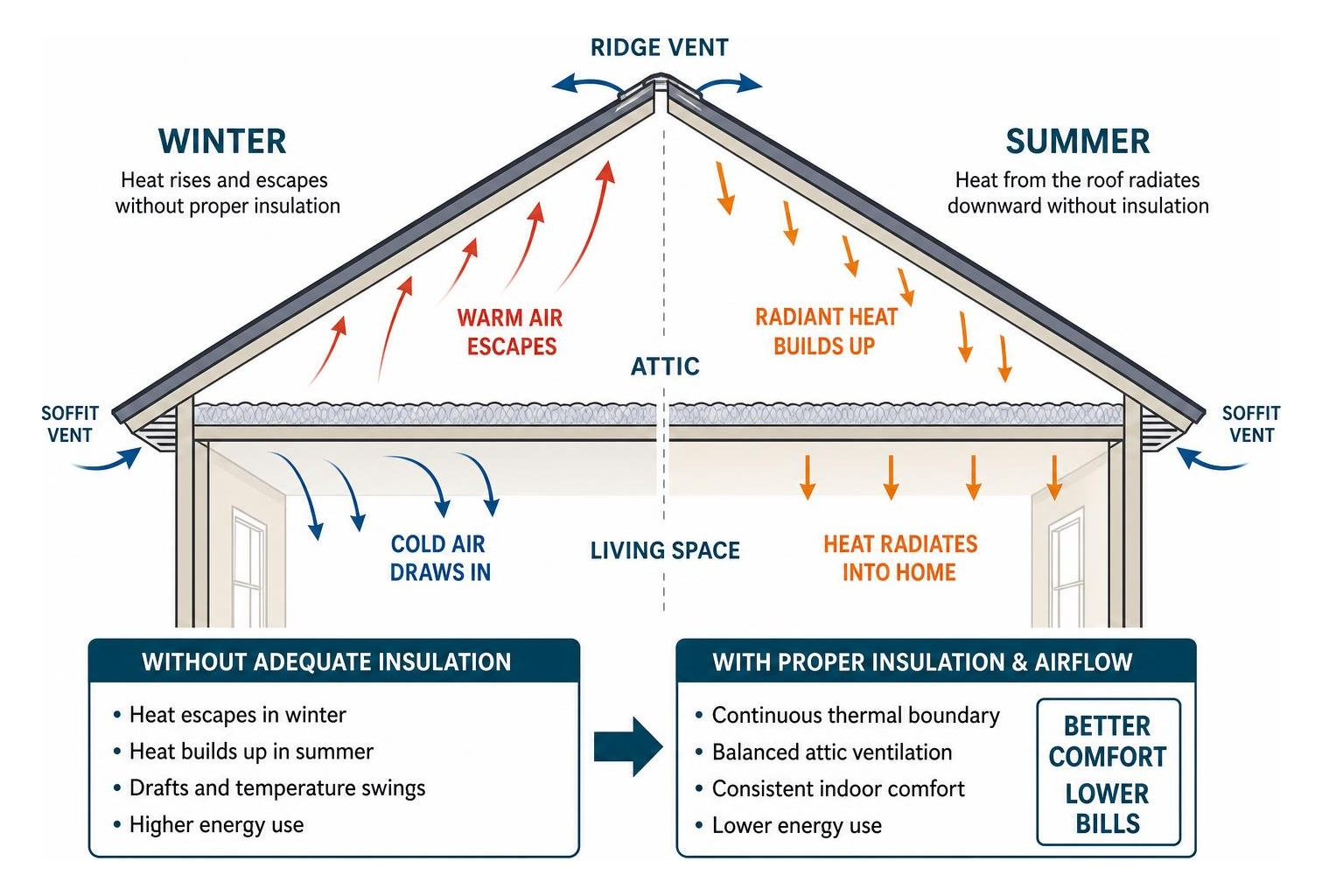
Upgrading your attic insulation establishes a dense, uniform thermal blanket that halts radiant and convective heat transfer. The immediate results include:
- Whole-Home Temperature Balance: Eliminating wide temperature swings between your main floor and upstairs bedrooms.
- Draft Elimination: Stopping the thermal buoyancy effect that pulls freezing winter air across your living room floors.
- Reduced HVAC Short-Cycling: Allowing heating and cooling systems to reach target thermostat settings quickly and maintain them efficiently.
- Extended Mechanical Service Life: Decreasing daily run time and mechanical stress on your furnace, heat pump, and air conditioning compressor, delaying costly system replacements.
When your thermal envelope performs correctly, your mechanical systems no longer have to work overtime just to keep your family comfortable.
3. Vital Roof Deck Protection and Moisture Prevention
The third critical reason to update your attic insulation involves protecting the structural integrity of your home. Your roof deck and attic framing are vulnerable to extreme temperature differentials and trapped indoor humidity. In cold northern climates like Metro Detroit, a poorly insulated attic floor causes serious winter roofing failures—most notably, destructive ice damming.
Ice dams occur when indoor heat leaks past the attic floor and warms the underside of the roof deck above freezing (32°F). Snow on the roof melts and runs down toward the cold eaves and gutters, where it refreezes into a thick ridge of ice. As more meltwater pools behind this ice dam, it has nowhere to drain and forces its way backward beneath your shingles, soaking into roof decking, ceiling insulation, and interior drywall.
A properly insulated and ventilated attic keeps the roof deck cold and uniform throughout winter, eliminating the root cause of ice damming.
Additionally, modern insulation upgrades address warm, moisture-laden air that escapes into cold attics during winter months. When humid indoor air contacts freezing roof sheathing, it condenses into liquid water or frost. Over time, this recurring moisture cycle causes:
- Wood Rot and Structural Decay: Softening roof rafters, trusses, and plywood decking.
- Premature Shingle Failure: Accelerating thermal degradation and granule loss on asphalt shingles.
- Hazardous Mold Growth: Spreading mold spores into attic materials and down into living spaces, compromising indoor air quality.
By coupling dense thermal insulation with balanced intake and exhaust ventilation, you preserve your roof system’s lifespan and protect your manufacturer warranty.
How Can You Tell If Your Attic Insulation Needs an Upgrade?
Many homeowners assume that because their attic contains some insulation, it must be performing adequately. In reality, industry research indicates that 90% of homes built before 2005 lack adequate attic insulation to meet modern energy efficiency and building code standards. Over time, materials settle, compress, degrade from moisture, or become displaced by tradespeople and pests.
You can perform a quick, 10-minute visual assessment right from your attic access hatch using a flashlight and a standard tape measure.
Physical Warning Signs Inside the Attic
- Visible Ceiling Joists: If the insulation is level with or sitting below the top of your 2×6 or 2×8 floor joists, your attic has an R-value of R-19 or less—far below recommended regional targets.
- Compressed or Matted Insulation: Fiberglass and cellulose rely on trapped air pockets (loft) to resist heat transfer. Trampled, flattened, or compacted material loses up to 50% of its rated thermal resistance.
- Pest Infestation and Biological Contamination: Rodent droppings, urine trails, and tunneling destroy insulation integrity, create foul odors, and pose biological hazards that necessitate full extraction and sanitation.
- Water Staining and Mold Spots: Dark patches, crusty surfaces, or musty smells indicate past roof leaks or severe condensation issues that have permanently ruined the material’s thermal properties.
- Presence of Vermiculite: Common in homes built prior to 1990, vermiculite looks like small, pebble-sized flakes with a metallic gold or gray-brown shine. Because vermiculite often contains asbestos, it should never be disturbed and requires professional testing.
Clear Performance Clues Throughout the Living Space
Your home will often exhibit subtle warning signs long before you ever climb into the attic:
- Noticeable Floor-to-Floor Temperature Splits: Upper levels feel significantly warmer in summer and colder in winter compared to the ground floor.
- Unexplained Spikes in Utility Bills: Heating and cooling costs steadily increasing despite consistent thermostat habits.
- Cold Ceilings and Walls: Interior ceiling drywall feeling cold to the touch during freezing weather.
- Chronic Winter Icicles: Heavy ice accumulation along gutter lines and exterior eaves after moderate snowfalls.
If your home displays two or more of these symptoms, scheduling a comprehensive assessment for high-performance attic insulation is the most effective next step.
Which Attic Insulation Materials Offer the Best Value and R-Value?
Insulation performance is measured in R-value, which quantifies a material’s resistance to conductive heat flow. The higher the R-value, the greater the insulating power. In Southeast Michigan (IECC Climate Zone 5), modern building codes recommend reaching an overall attic floor level between R-49 and R-60.
Selecting the right material depends on your attic’s structural layout, existing insulation condition, and overall energy goals.
| Insulation Material | R-Value Per Inch | Air-Sealing Capability | Moisture Resistance | Best Application |
|---|---|---|---|---|
| Blown-In Cellulose | R-3.5 – R-3.8 | High (Dense Pack) | Moderate (Borate Treated) | Open attic floors, irregular joist bays, retrofits |
| Blown-In Fiberglass | R-2.5 – R-3.2 | Low to Moderate | High | Clean open attic floors, topping off dry fiberglass |
| Fiberglass Batts | R-2.9 – R-3.8 | Very Low | Moderate | Standard, un-obstructed joist framing (new construction) |
| Spray Foam (Closed-Cell) | R-6.0 – R-7.0 | Complete Air/Vapor Barrier | Exceptional | Unvented rooflines, conditioned attics, cathedral ceilings |
| Spray Foam (Open-Cell) | R-3.5 – R-3.8 | High Air Barrier | Permeable | Roofline applications in moderate climate conditions |
Material Breakdown: Blown-In Cellulose vs. Fiberglass vs. Spray Foam
Blown-In Cellulose
Manufactured from up to 85% recycled post-consumer newsprint and treated with non-toxic borate mineral salts, blown-in cellulose is the gold standard for attic floor retrofits. It provides excellent thermal resistance (~R-3.5 to R-3.8 per inch) and packs tightly around wiring, pipes, and irregular joists. The borate treatment provides natural resistance against pests, mold, and flame spread, while its dense physical structure significantly impedes convective air currents.
Loose-Fill vs. Batt Fiberglass
While fiberglass batt insulation is common in new construction, it performs poorly in existing attic retrofits. Batts are difficult to cut and fit perfectly around electrical boxes, joist braces, and plumbing penetrations. Loose-fill blown fiberglass avoids this issue by creating a seamless blanket over irregular surfaces, though it does not block airflow as effectively as dense cellulose.
Spray Polyurethane Foam
Spray foam creates an impermeable thermal and air boundary. Closed-cell spray foam provides an unmatched R-value per inch (R-6.5+) and structural rigidity. However, spray foam is best reserved for specialized applications—such as unvented roof deck assemblies where HVAC ductwork runs directly through the attic space—whereas blown loose-fill on the attic floor remains the most practical and efficient solution for standard vented attics.
Why Air Sealing Multiplies Insulation Performance
Adding new insulation without air sealing is like putting on a thick wool sweater on a windy winter day without a windbreaker. Air easily passes right through loose insulation fibers, carrying thermal energy with it.
During the air-sealing and insulation process, it is equally critical to install 1.5-inch ventilation baffles (rafter vents) at every soffit intake bay. These baffles prevent blown insulation from spilling into the eaves and choking off fresh airflow, ensuring your roof system breathes properly and maintains its long-term durability.
Why Should You Choose Professional Installation for Your Attic Upgrade?
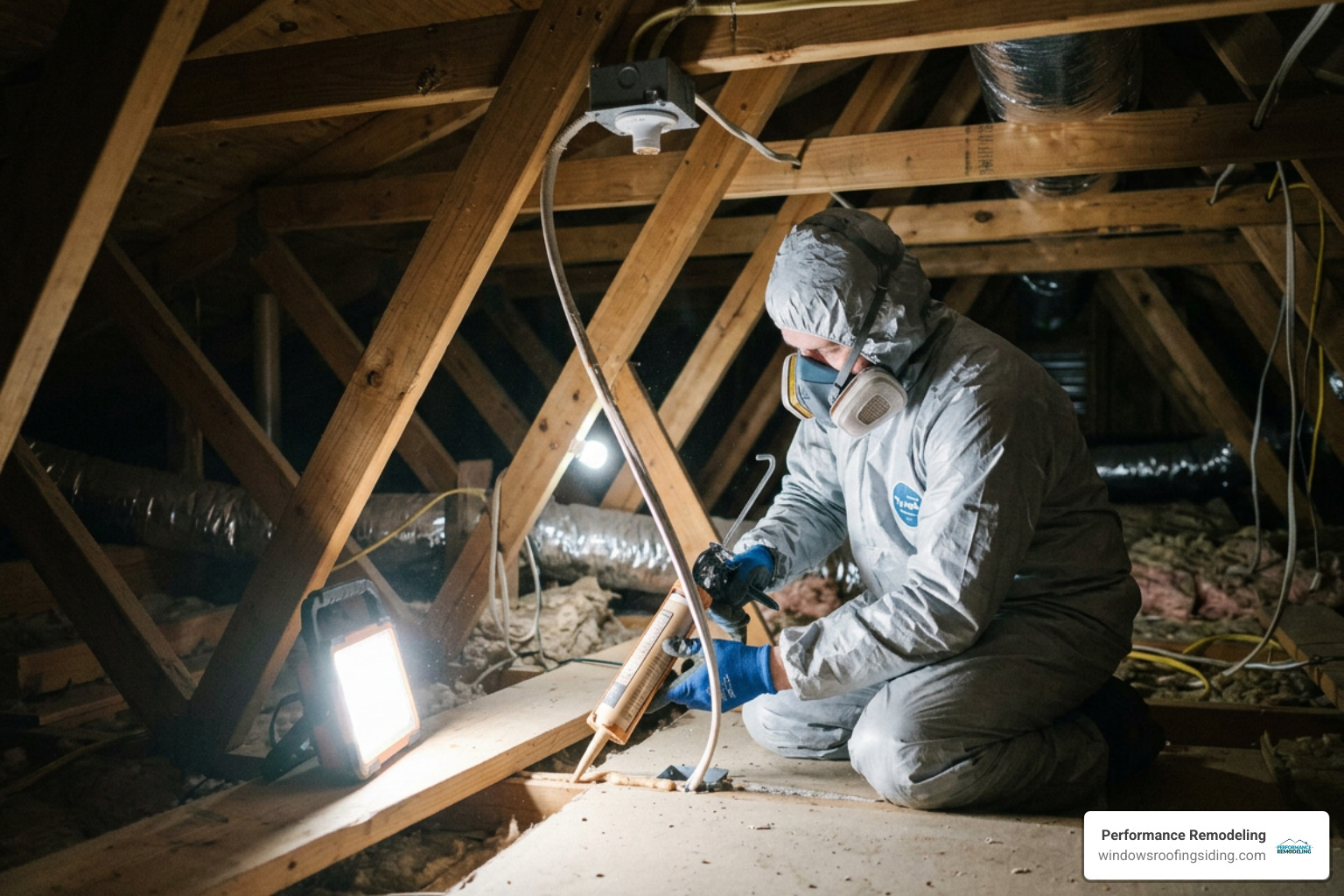
While blowing insulation is sometimes marketed as a DIY weekend project, achieving true building-science-backed results requires specialized tools, protective equipment, and deep technical knowledge.
Attics harbor numerous hidden hazards and architectural complexities:
- Concealed Electrical Hazards: Older homes throughout Oakland, Wayne, and Macomb counties frequently contain active knob-and-tube wiring, unsealed junction boxes, or overheating-prone non-IC-rated recessed light fixtures that pose severe fire risks if covered improperly.
- Ventilation Blockages: Inexperienced installers often blow insulation directly over soffit intake vents. This starves the attic of airflow, leading to rapid moisture buildup, structural mold rot, and roof shingle blistering.
- Improper Vapor Barrier Sequencing: Installing faced batts over existing insulation traps condensation between the two layers, creating a hidden breeding ground for rot and mold.
- Structural Safety: Navigating narrow joist framing without damaging ceiling drywall or risking personal injury requires professional training and safety rigging.
At Performance Remodeling, we approach attic upgrades through a complete building envelope lens. Since 2006, we’ve provided local craftsmanship across Southeast Michigan and Metro Detroit, our technicians evaluate your attic’s framing, ventilation balance, and air leakage points simultaneously. Every project we complete is supported by our industry-leading lifetime guarantee, giving homeowners absolute peace of mind that their thermal envelope will perform reliably for decades.
Moreover, our team helps homeowners synchronize their attic insulation projects with comprehensive exterior home improvement services, including complete roofing, replacement windows, and siding retrofits, ensuring optimal exterior weatherization from top to bottom.
Frequently Asked Questions About Attic Insulation Upgrades?
Can you add new insulation directly over old attic insulation?
Yes, provided the existing insulation is completely dry, clean, and structurally sound. Adding a fresh layer of unfaced blown-in cellulose or loose-fill fiberglass over old insulation is an effective way to raise your attic’s overall R-value.
However, existing insulation must be completely removed if it shows any signs of:
- Active mold growth or mildew odors.
- Water damage, matting, or past soaking from roof leaks.
- Rodent waste, biological contamination, or extensive pest nesting.
- Suspected vermiculite containing asbestos.
Never install faced insulation (insulation with a paper or foil vapor retarder) on top of existing insulation, as this traps moisture within the lower layers.
What is the recommended R-value for an attic upgrade in 2026?
For residential homes in Southeast Michigan (Climate Zone 5), modern building energy codes recommend an attic insulation depth of R-49 to R-60. Achieving an R-49 to R-60 rating requires approximately 14 to 18 inches of blown-in cellulose or 16 to 20 inches of loose-fill fiberglass. If your current attic insulation measures 6 to 8 inches or less, adding material to meet modern standards will yield substantial improvements in efficiency and comfort.
How Does Upgrading Your Attic Insulation Protect Your Home’s Future?
Updating your attic insulation is far more than a simple maintenance chore—it is a high-return home investment that delivers three essential benefits: lower monthly energy bills, consistent year-round indoor comfort, and lasting structural roof protection.
With extreme weather patterns testing our homes every season, having an adequate thermal barrier ensures your living spaces remain comfortable while shielding your wallet from volatile energy rate spikes. Taking action before the expiration of current federal tax credits allows you to optimize your savings while securing your home against moisture, drafts, and ice damming.
To learn more about maximizing your home’s energy efficiency and structural performance, explore our educational guides on our blog.
When you are ready to eliminate drafts, lower your energy bills, and protect your roof with Michigan’s leading lifetime guarantee, contact the experienced team at Performance Remodeling to schedule your professional attic evaluation through our complete services portal.