
Fiberglass vs Steel Door Weight at a Glance
For a standard 36-by-80-inch entry door, a steel slab weighs about 45 pounds and a comparable fiberglass slab weighs about 37 pounds. As prehung units, steel is often about 52 pounds, while fiberglass is about 40 pounds. In practical terms, fiberglass can reduce the hanging weight by roughly 8 to 12 pounds per door, or about 25% for a typical prehung unit.
That difference matters when choosing fiberglass vs steel door weight for a Metro Detroit home. A lighter door is easier to carry and hang, puts less ongoing stress on hinges and jambs, and can feel easier to open for children, older adults, and anyone with limited mobility.
Weight alone does not determine insulation or security. Both materials commonly use insulating foam cores, and a well-installed frame, weatherstripping, hinges, and deadbolt matter more than a few pounds of slab weight. Still, fiberglass does not conduct heat like steel, which can help reduce cold surface temperatures and condensation during Michigan winters.
At Performance Remodeling, we help homeowners compare the complete door system – not just the slab – so the finished entry is secure, smooth-operating, and built for local weather.
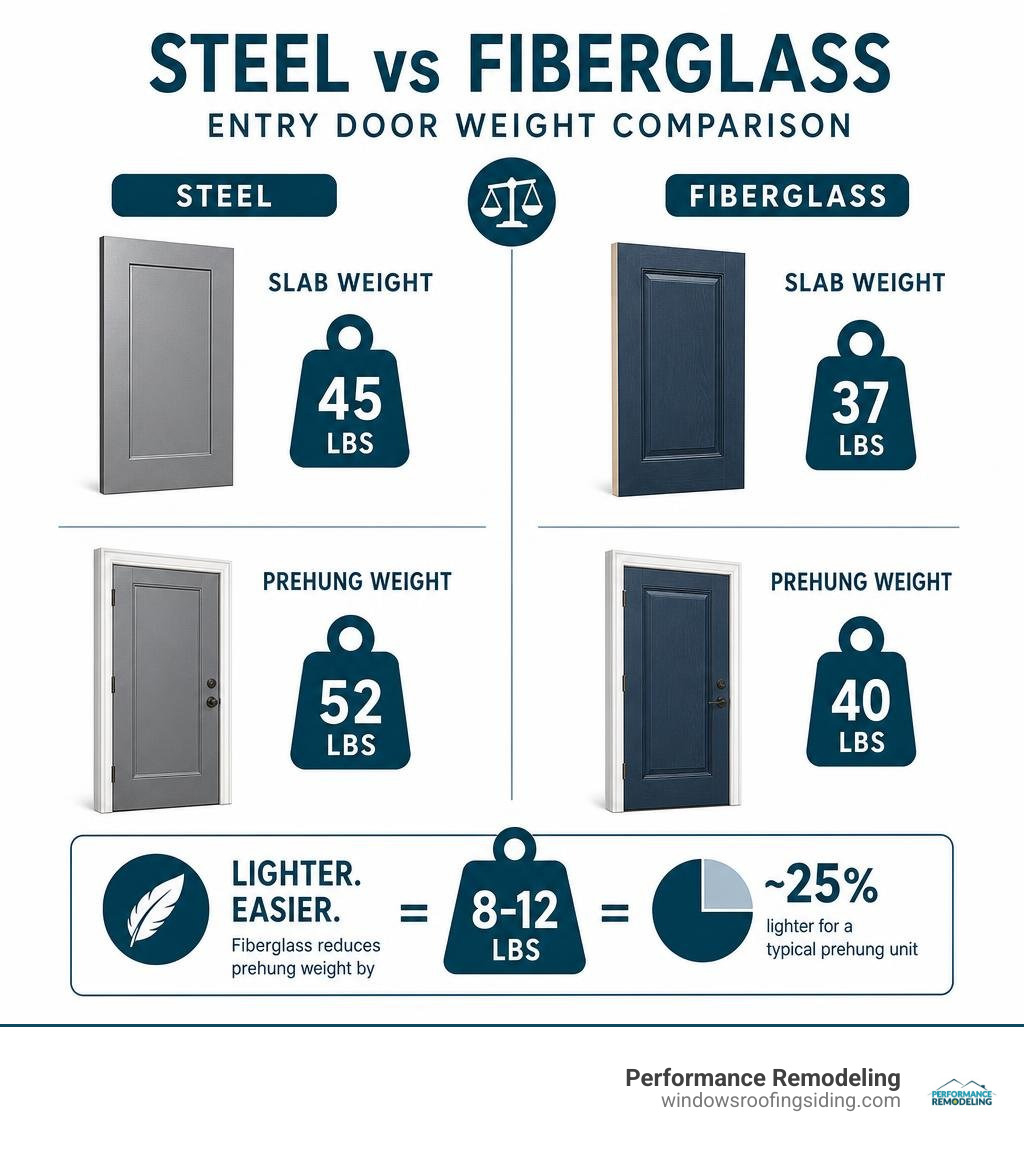
Fiberglass vs Steel Door Weight: The Complete Head-to-Head Breakdown
When evaluating exterior doors, many homeowners assume steel doors are solid slabs of dense metal. In reality, modern residential exterior doors use composite engineering. Both residential steel and fiberglass doors rely on an energy-efficient core surrounded by an outer protective skin.
A standard residential steel door is built from 24-gauge galvanized steel sheeting wrapped around an insulating expanded polystyrene or polyurethane core. Fiberglass doors utilize compression-molded glass-fiber reinforced polyester or vinyl ester skins over a high-density polyurethane core and internal composite stiles.
While raw structural steel is significantly denser than composite fiberglass—fiberglass as a raw material is roughly 75% lighter than steel—the finished residential slabs are closer in weight because both rely on lightweight foam cores. However, that physical weight difference still fundamentally alters how the door performs over decades of seasonal use.
| Material Type | Typical Slab Weight (36″ x 80″) | Typical Prehung Weight (36″ x 80″) | Weight Range (Based on Options) | Core Construction | Primary Failure Mode |
|---|---|---|---|---|---|
| Fiberglass | 37 – 50 lbs | 40 – 65 lbs | 50 – 100 lbs (with decorative glass) | Polyurethane Foam | UV surface fading / high-point impact cracks |
| Steel (24-Gauge) | 45 – 80 lbs | 52 – 100 lbs | 60 – 100+ lbs (with glass inserts) | Polyurethane or Polystyrene Foam | Denting, surface rust, frame sagging |
| Solid Wood | 45 – 60 lbs | 70 – 115 lbs | 60 – 150+ lbs | Solid Timber Core | Warping, rotting, moisture absorption |
| Aluminum | 30 – 45 lbs | 45 – 70 lbs | 40 – 80 lbs | Polyurethane Foam | Metal oxidation, scratching, denting |
As outlined in Bob Vila’s entry door comparison guide, modern manufacturing allows both materials to achieve superior durability compared to old-growth wood slabs, but the extra mass of steel changes the mechanical loads placed on your home’s framing.
Analyzing Fiberglass vs Steel Door Weight in Prehung vs Slab Units
The distinction between a door slab and a prehung door system is where weight differences become critical for installation ergonomics and structural alignment. A door slab is simply the rectangular door panel itself, while a prehung unit includes the slab already hung on hinges within a three-sided frame with an integrated threshold.
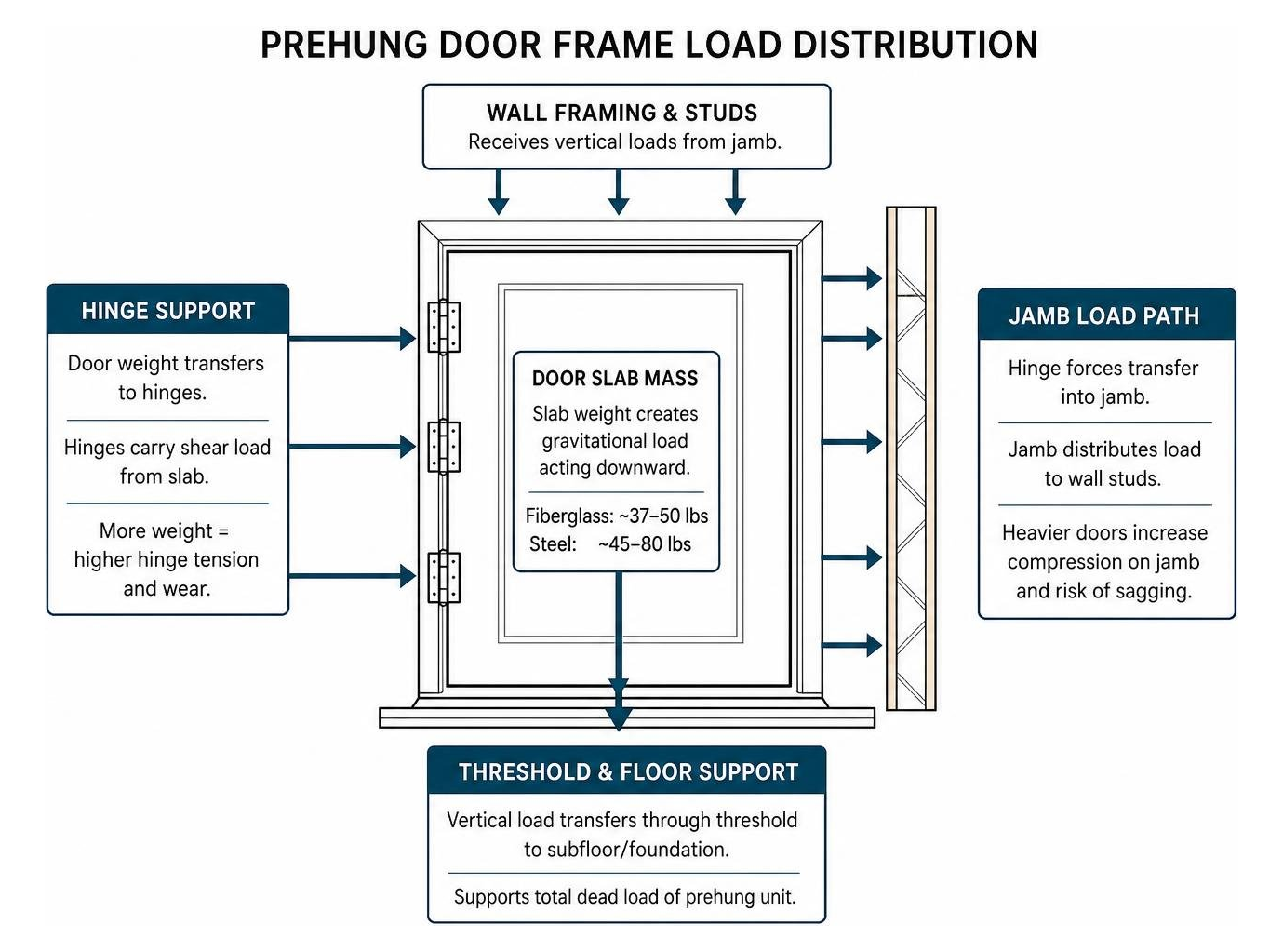
Whether you are fitting a large main entrance or standard 32×80 front doors for a secondary side entry, prehung steel assemblies add measurable dead load during transport and installation. A standard 36×80-inch fiberglass prehung unit averages around 40 to 50 pounds, making it manageable for a single experienced carpenter to maneuver and shim square.
In contrast, a 52-to-100-pound steel prehung assembly often requires two installers to position, balance, and fasten without twisting the jamb. During shipping and delivery across Metro Detroit jobsites, the extra weight of steel units increases the risk of prehung frames racking or shifting out of square before the unit is even fastened to the rough opening studs.
Material Density: How Fiberglass and Steel Compare to Wood and Aluminum
To understand why these weight discrepancies exist, we have to look at the structural density and strength-to-weight ratios of the raw materials:
- Fiberglass Composites: Boasting a tensile strength of up to 1,000 MPa with a density roughly 75% lower than steel and 50% lighter than aluminum, fiberglass delivers immense rigidity without requiring thick, heavy walls.
- Galvanized Sheet Steel: Steel has a high elastic modulus (210 GPa) and exceptional compressive strength, but its high density means even a thin 24-gauge or 20-gauge skin adds noticeable pounds to the slab.
- Solid Hardwood: Wood doors range from 45 to over 100 pounds. While naturally beautiful, wood lacks an insulated core and absorbs ambient humidity, causing seasonal weight fluctuations and swelling.
- Extruded Aluminum: Lightweight and rigid, aluminum is easier to handle but conducts thermal energy rapidly and is more susceptible to cosmetic denting than thick composite fiberglass.
When molded into classic architectural profiles, such as a classic 6 panel exterior door, fiberglass mimics the deep shadow lines and authentic grain of natural oak, mahogany, or fir without carrying the cumbersome weight of solid timber or the rigid industrial heft of steel.
Structural and Hardware Impacts: Why Door Weight Matters

Every pound hanging on an exterior entryway exerts a continuous downward and lateral pull on the mounting hardware. When a door is closed, its weight is distributed across the hinges and into the framing studs. But the moment that door swings open, the weight creates a cantilevered rotational torque.
Over time, this mechanical leverage dictates how often you will need to adjust your latches, replace weatherstripping, or re-align binding frames.
How Fiberglass vs Steel Door Weight Impacts Long-Term Hardware Wear
Gravity never takes a day off. On a heavier steel door, continuous gravitational pull leads to hinge fatigue. As the top hinge pin and leaf experience continuous tensile stress, microscopic gaps open up in the knuckle joints.
This dynamic leads to several common structural issues:
- Hinge Sag: The top hinge stretches slightly or pulls its fastening screws loose from the wood framing, causing the door slab to drop at the latch side.
- Latch Binding: As the door sags, the deadbolt and latch bolt no longer align smoothly with the strike plate mortises, requiring homeowners to lift or pull hard on the handle to lock the door.
- Threshold Drag: The bottom sweep rubs heavily against the sill, wearing out bottom seals and introducing air infiltration.
According to a detailed durability and weight analysis, the lighter mass of fiberglass drastically minimizes this cycle of mechanical wear. By placing 25% to 40% less strain on the hinges, fiberglass doors maintain their factory reveal (the uniform gap around the door perimeter) for decades with virtually no hinge adjustments.
Daily Operation, Ergonomics, and Accessibility Concerns
Beyond long-term hardware durability, door weight plays a direct role in everyday usability. Heavy doors possess greater swing inertia. Once in motion, a heavy steel slab requires more physical effort to stop, which increases the risk of pinched fingers if a gust of wind catches the door.
For households with young children, seniors, or family members with mobility challenges, operating force is a major quality-of-life consideration. Lighter fiberglass doors require lower initial push-pull force, effortlessly meeting accessibility guidelines without sacrificing structural stability.
Furthermore, the physical composition of the door impacts modern smart home integration. The heavy metallic shell of a steel door can attenuate radio frequencies, occasionally causing Wi-Fi or Bluetooth connectivity drops on smart locks and video doorbells mounted directly to the door face. Fiberglass, being an RF-transparent composite material, allows wireless signals to pass through freely.
Thermal Performance, Energy Efficiency, and Climate Resilience
In Southeast Michigan, our entryways face dramatic weather swings—from humid, 90-degree summer afternoons to sub-zero winter nights. How a door handles temperature differentials depends not only on its core insulation but also on the thermal conductivity of its outer skin.
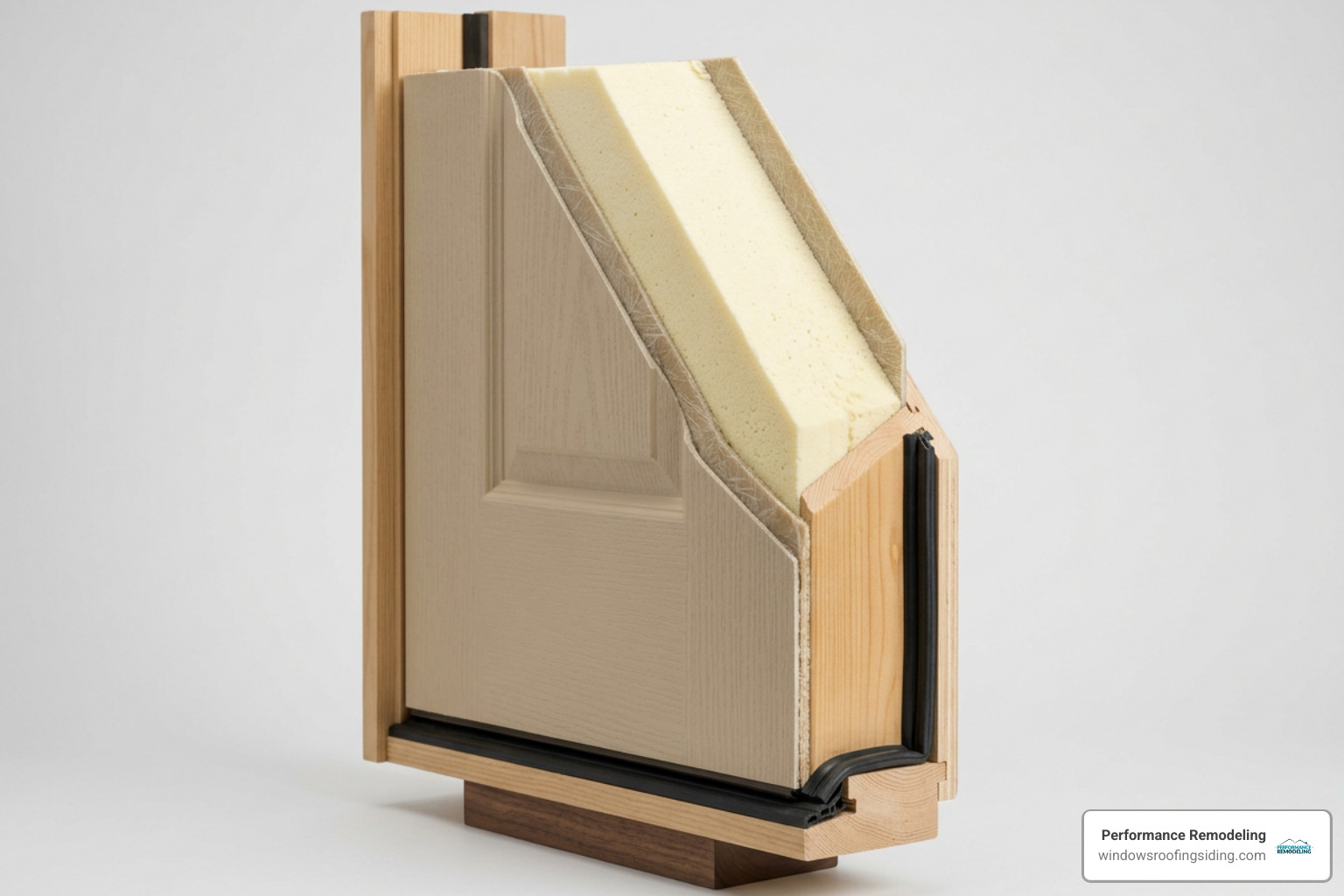
Core Insulation vs Surface Weight: R-Values and Thermal Conductivity
Both steel and fiberglass doors achieve impressive insulation ratings—typically ranging from R-5 to R-6 for windowless solid designs—largely because both utilize dense polyurethane insulating foam cores. However, their surface skins behave very differently when exposed to direct heat or freezing winds.
- Steel Thermal Conductivity: Carbon steel has a thermal conductivity rating of roughly 15 to 45 W/mK. Metal conducts thermal energy rapidly, meaning heat escapes quickly in the winter and solar radiation bakes the interior face in the summer. Without a continuous thermal break along the perimeter edges, a steel door can feel ice-cold to the touch.
- Fiberglass Thermal Conductivity: Fiberglass composites have a thermal conductivity rating of only 0.25 to 0.35 W/mK. Fiberglass conducts heat up to 40 times slower than steel, acting as a natural insulator.
When investing in custom entry doors, choosing a non-conductive fiberglass material prevents the door surface from acting as a massive thermal bridge, lowering overall HVAC strain throughout harsh freeze-thaw cycles.
Weatherstripping Compression and Freeze-Thaw Stability
An entry door’s real-world energy efficiency is only as good as its perimeter seal. If a heavy door sags even an eighth of an inch, the compression weatherstripping along the top corner pulls away, creating an open draft path.
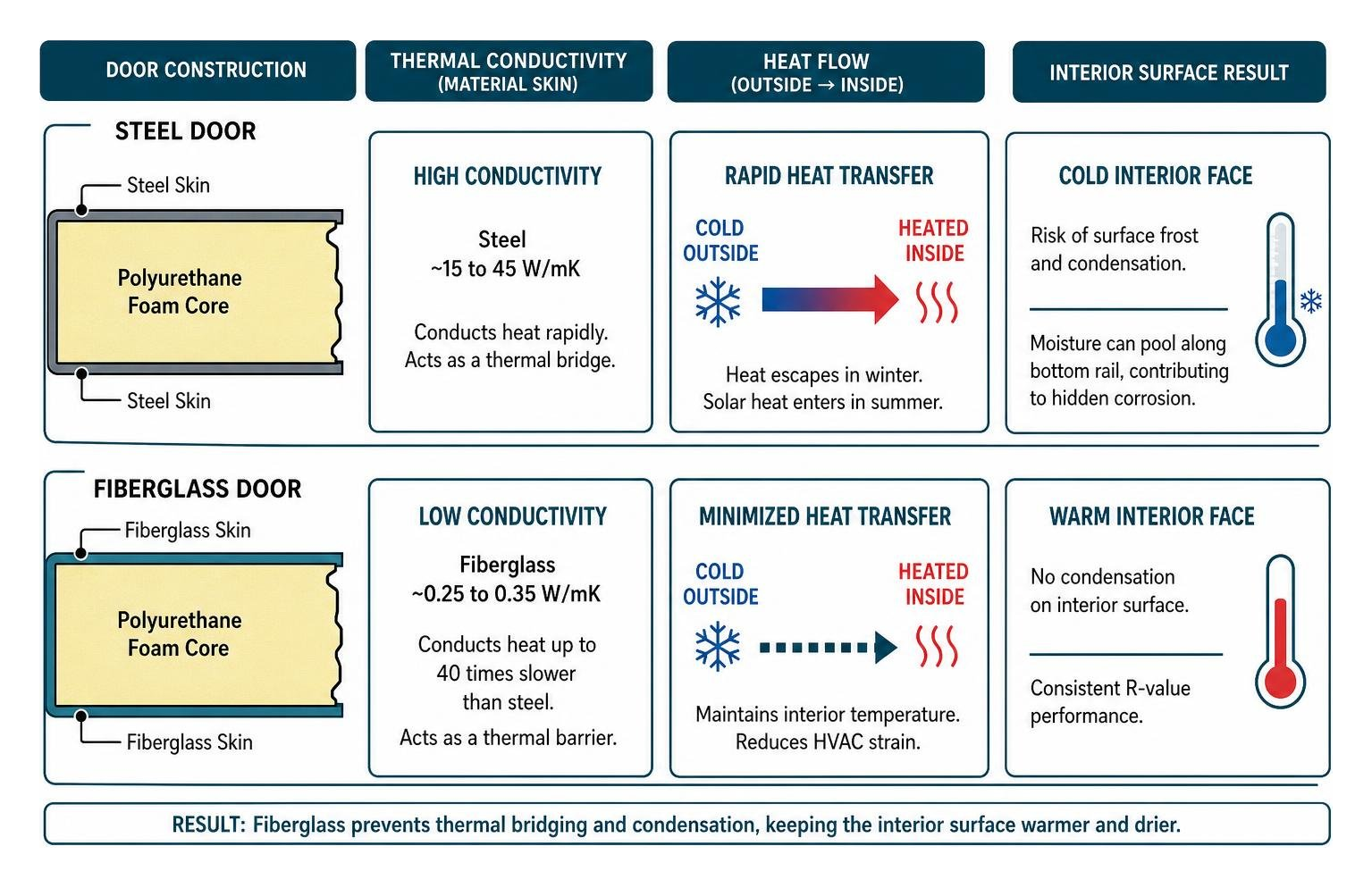
Additionally, steel expands and contracts under extreme temperature shifts. In high-humidity Michigan winters, rapid conductive cooling on steel doors can create internal surface condensation where warm indoor air strikes the cold metal skin. Over time, that moisture can pool along the bottom rail, contributing to hidden corrosion. Fiberglass remains dimensionally stable across temperatures ranging from -40°F to over 200°F, ensuring compression seals remain tight year-round.
Durability, Security, and Long-Term Cost Implications
Homeowners frequently ask us if shedding slab weight compromises security or physical toughness. Let’s look at how material properties dictate real-world impact resistance, home protection, and return on investment.
Impact Resistance and Forced Entry Protection
There is an important distinction between tensile strength and compressive dent resistance:
- Elastic Recovery (Fiberglass): Fiberglass skins possess high tensile flexibility. When hit with moderate impacts—such as a stray basketball, an accidental kick, or moving furniture—the composite skin flexes and bounces back to its original shape without leaving a mark.
- Plastic Deformation (Steel): While steel offers higher raw compressive hardness, thin 24-gauge sheet steel undergoes plastic deformation when struck. Once a steel door gets dented, pulling that dent out and restoring a smooth finish is exceptionally difficult.
When it comes to residential break-ins, security is rarely decided by whether an intruder can punch a hole through the door slab itself. In almost all residential forced-entry attempts, the failure point is the wooden door jamb or strike plate splitting open under blunt force.
Whether your entryway features decorative multi-lite front doors or a solid panel design, pairing the door with a reinforced security strike plate, 3-inch installation screws driven deep into the wall’s structural 2×4 framing studs, and a Grade 1 deadbolt delivers maximum protection regardless of slab material.
Total Cost of Ownership and Resale Value
Upfront, steel doors are typically more budget-friendly, making them attractive for rental units or fast renovations. However, evaluating the 20- to 50-year lifecycle paints a very different financial picture:
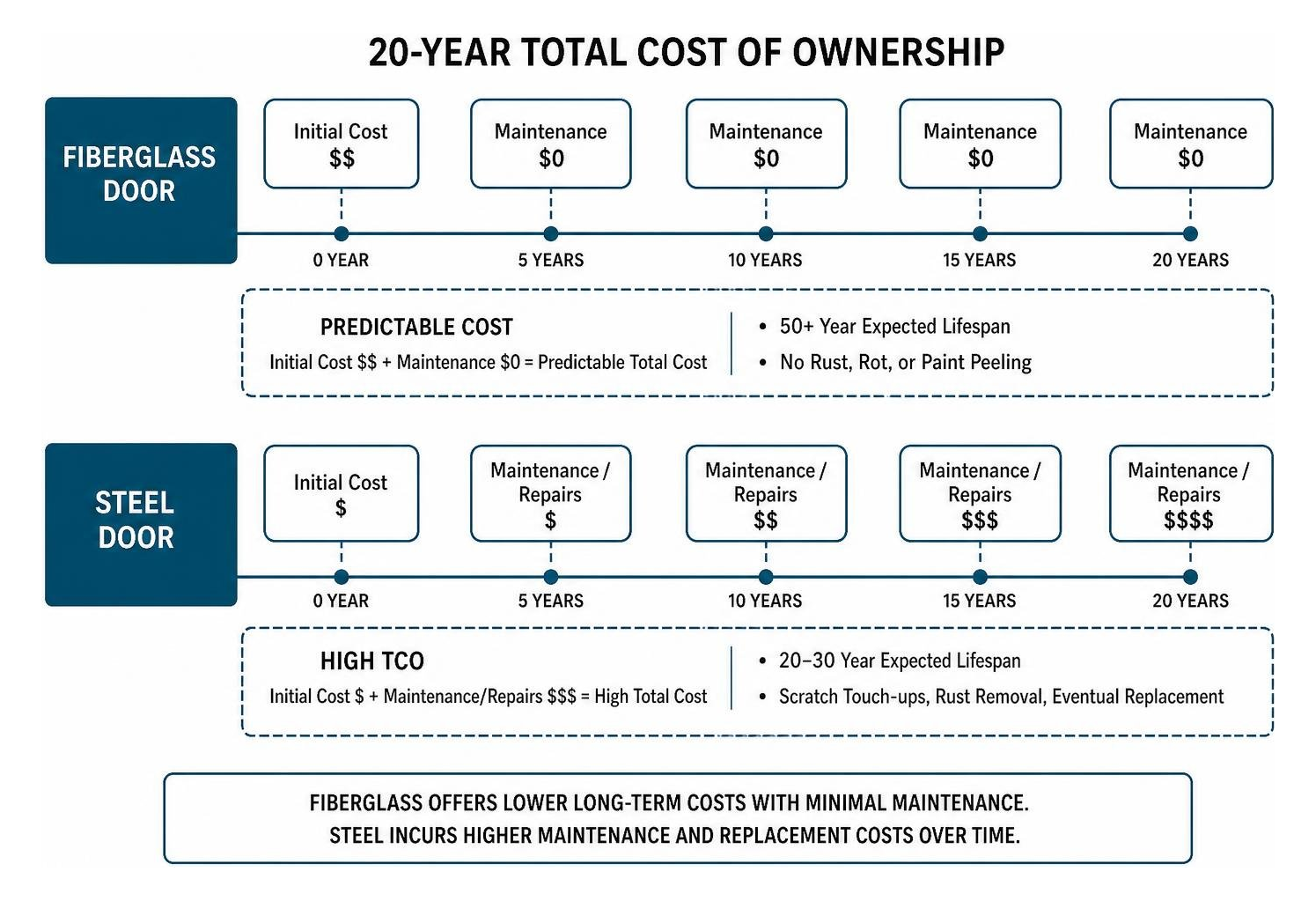
- Maintenance Demands: If a steel door gets scratched down to bare metal, moisture in the air will trigger oxidation, leading to rust bubbles beneath the paint within a few seasons. Fiberglass is completely chemically inert—it cannot rust, rot, corrode, or delaminate when exposed to road salt or rain.
- Longevity: A high-quality fiberglass door carries a functional lifespan of 50+ years with minimal maintenance beyond an occasional wipe-down with mild soapy water. Steel doors generally last 20 to 30 years before bottom-edge corrosion or accumulated dents necessitate replacement.
- Resale Value: While steel entry replacements historically boast strong upfront ROI percentages due to their lower initial material purchase price, premium fiberglass doors dramatically elevate curb appeal and offer lasting architectural value.
Frequently Asked Questions About Fiberglass and Steel Door Weight
How much lighter is a fiberglass door than a steel door?
On average, a standard 36×80-inch fiberglass door slab weighs between 37 and 50 pounds, while a comparable steel slab weighs 45 to 80 pounds. As a complete prehung unit, fiberglass is roughly 25% lighter (about 40 lbs vs 52+ lbs for steel). This weight savings makes fiberglass easier to install, simpler to balance, and significantly gentler on mounting hardware over time.
Does a heavier steel door provide significantly better home security?
Not in typical residential applications. Real-world forced-entry resistance depends almost entirely on the quality of the lock hardware, frame reinforcement, and strike plate anchoring. Because burglars attack the latch and frame rather than attempting to break through the center of the door slab, a properly installed fiberglass door with heavy-duty strike plates anchored into the rough wall framing provides break-in protection equal to that of a steel door.
Will a heavy steel entry door damage my existing door frame over time?
A heavy steel door can accelerate frame wear if installed on an aging or unreinforced wood jamb. Over years of use, the cantilevered weight of a steel slab can pull top hinge screws loose, cause the jamb to sag out of square, and lead to binding along the latch side. If installing a heavier steel door, it is critical to use long 3-inch framing screws through the hinges and ensure the rough opening framing is structurally sound.
Conclusion
Choosing between fiberglass and steel comes down to balancing weight, long-term maintenance, and daily usability. While steel offers a sturdy, economical entry point, fiberglass delivers superior strength-to-weight performance, eliminating hinge sag, resisting everyday dents, and providing exceptional thermal resistance against harsh Michigan winters.
For homeowners in Southeast Michigan and across the Greater Metro Detroit area, choosing the right door means selecting a complete system designed to withstand our unique four-season climate. If you are comparing steel doors vs fiberglass doors for an upcoming entryway upgrade, our team brings over 18 years of local craftsmanship to every project. We back our exterior remodeling installations with the best lifetime guarantee in the region, ensuring your new front entry opens smoothly, seals tightly, and protects your home for decades to come.