
What Are High Lift Garage Doors — and Do You Need One?
High lift garage doors are a specialized garage door system that allows your door to travel much higher up the wall before curving horizontally along the ceiling — giving you significantly more usable vertical space than a standard door.
Here’s a quick summary:
- What it is: A custom track system that raises the point where the door curves, maximizing overhead clearance
- How much space it adds: Up to 15 extra inches of headroom compared to a standard door
- Who it’s for: Homeowners with car lifts, tall vehicles, RV storage, or overhead storage needs
- What it requires: Ceiling height of at least 12–14 feet, plus specialized tracks, springs, drums, and a jackshaft opener
- Can you convert an existing door? Yes — in most cases, your existing door panel can be reused with new hardware
Most standard garage doors open to a height of just 7–8 feet. That’s fine for everyday use. But if you’ve ever tried to fit a truck, install a car lift, or add serious overhead storage, you already know that clearance disappears fast.
That’s exactly the problem high lift garage door systems solve.
We’ve worked on garages across Metro Detroit and Southeast Michigan for years. When homeowners start thinking about car lifts or want to reclaim that dead space above their heads, this is almost always the conversation we end up having. It’s one of those upgrades that looks simple on the surface — but gets technical quickly.
This guide walks you through everything: how the system works, what it costs, how to calculate your maximum lift, and when to call a professional instead of attempting it yourself.
Understanding High Lift Garage Doors and Their Benefits
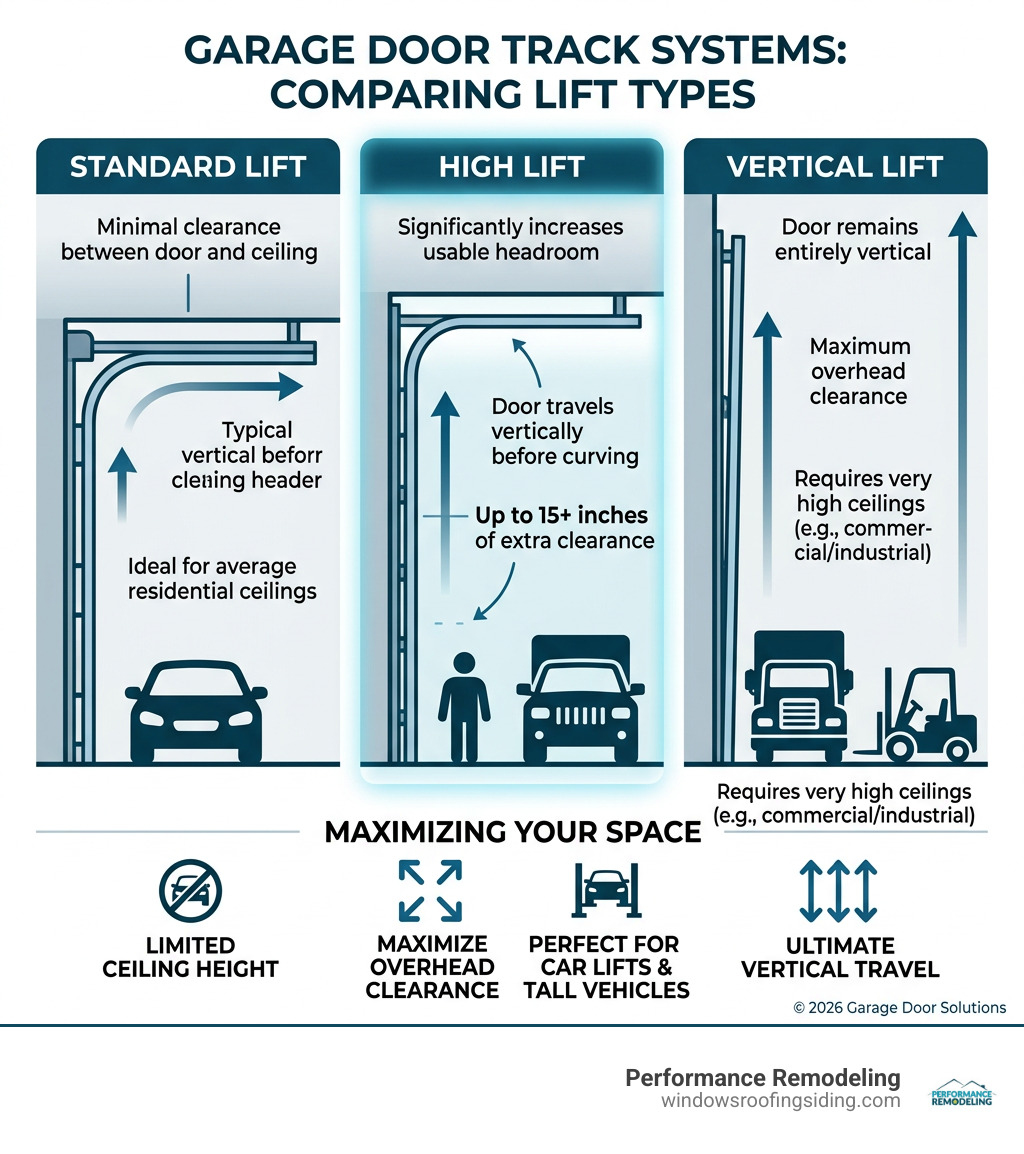
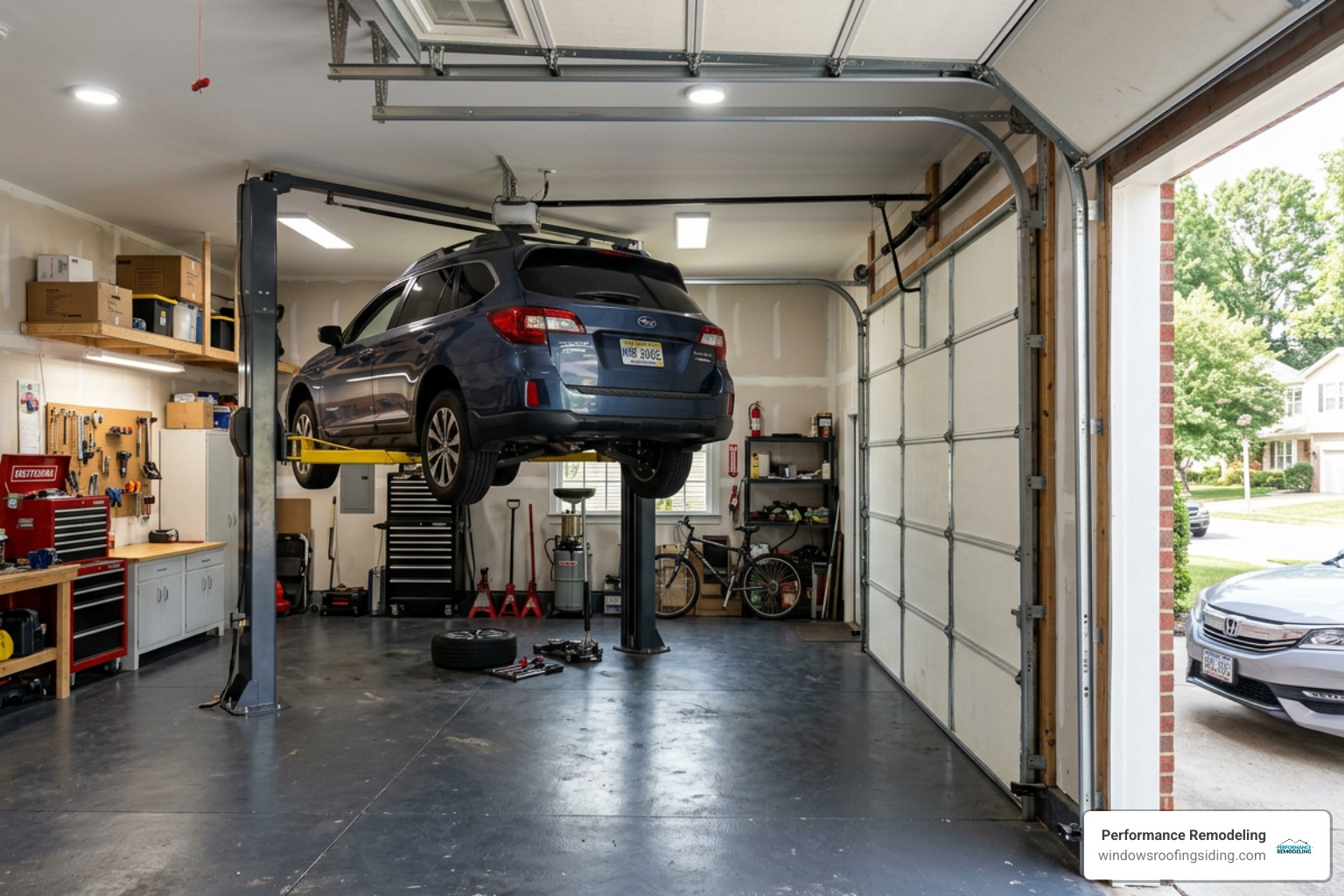
At its core, a high lift garage door is all about vertical travel. In a standard setup, your garage door starts to turn toward the horizontal tracks almost immediately after clearing the top of the door opening (the header). With a high lift system, we extend those vertical tracks higher up the wall. The door “hugs” the wall for several additional feet before finally making that turn toward the ceiling.
Why go through the trouble? The benefits are more than just aesthetic:
- Ceiling Optimization: You stop wasting the top 4 to 6 feet of your garage. This is “dead space” in 90% of American homes.
- Massive ROI: According to DASMA, replacing or upgrading a garage door can offer a return on investment of up to 193%. It is consistently one of the top home improvement projects for recouping costs.
- Curb Appeal and Value: Beyond the internal utility, these systems allow for larger, more impressive door designs that can significantly boost your home’s market value.
- Engineering Precision: Unlike standard doors that rely on simple gravity and basic springs, high lift systems use complex Garage Door Engineering Formulas to ensure the door remains balanced even as it travels higher.
Common Applications for High Lift Garage Doors
In our experience serving areas from Novi to Shelby Township, we see a few “usual suspects” when it comes to who needs these doors:
- The Car Enthusiast: If you want to stack cars using a four-post or two-post lift, you need the garage door to stay out of the way. A standard door would sit right where the roof of your top car needs to be.
- RV and Tall Vehicle Owners: If you’ve upgraded to a lifted truck or a Sprinter van, standard 7-foot clearances simply won’t cut it.
- Home Gym Junkies: Nothing ruins a morning workout like hitting a garage door track while doing overhead presses or pull-ups.
- Maximum Storage: By moving the tracks up, you open up the walls for heavy-duty shelving or overhead racks that can hold seasonal gear.
Pros and Cons of High Lift Systems
Like any major home modification, there are trade-offs to consider.
The Pros:
- Unmatched Space: It is the single most effective way to increase garage volume without an addition.
- Custom Aesthetics: These systems feel “industrial-chic” and high-end.
- Durability: Because they are engineered for higher travel, the hardware is often beefier than standard residential kits.
The Cons:
- Strict Structural Requirements: Your garage framing must be sound enough to handle the increased leverage and weight of the extended tracks.
- Specialized Hardware: You can’t just use “off-the-shelf” parts from a big-box store.
- Maintenance: Because the springs are under more tension and the cables are longer, you’ll want to keep a closer eye on wear and tear.
Technical Requirements and Components for a High Lift System
A high lift garage door isn’t just a standard door with longer tracks. It’s a re-engineered machine. When we perform a conversion in Metro Detroit, we aren’t just adding height; we are changing the physics of how the door moves.
The geometry of the track is the most visible change. While standard tracks have a simple curve, high lift tracks feature an extended vertical run. This requires specialized materials, often 304 stainless steel for those looking for maximum corrosion resistance in our Michigan winters. You’ll also choose between 2-inch tracks (standard residential) or 3-inch tracks (heavy-duty/industrial) depending on the door’s weight. For those looking for specialized industrial hardware, checking out Dock Leveler Parts and Accessories can give you an idea of the heavy-duty components often adapted for these high-performance systems.
Essential Components for High Lift Garage Doors
To make this system work safely, several parts must be swapped out:
- High Lift Drums: Standard drums are flat. High lift drums are tapered. This taper is crucial because it changes the “moment arm” as the door rises, balancing the weight as more of the door becomes horizontal.
- Recalibrated Torsion Springs: Because the door stays vertical longer, the springs have to work harder for a longer duration. We often use “shot peened” springs, like those in the Clopay Extreme™ Series, which can last 50,000 cycles — five times longer than standard springs.
- Longer Cables: Since the door travels further, you need extra cable length to reach the bottom brackets.
- Heavy-Duty Bearings: The increased stress on the shaft requires industrial-grade bearings to prevent squeaking and premature failure.
Compatible Garage Door Openers
This is a big one: You cannot use a standard trolley-style (center-rail) opener with a high lift door.
Since the door moves up the wall, a center rail would be in the way of the door’s path. Instead, we use Jackshaft Openers (also called side-mount motors). The LiftMaster 8500W is the gold standard here. It mounts on the wall next to the torsion bar, turning the shaft directly.
Benefits of Jackshaft Openers:
- Ceiling Clearance: Keeps the space above the door completely open.
- Vibration Reduction: Wall mounting is often much quieter than ceiling mounting.
- Smart Features: Most modern units come with Wi-Fi, battery backups, and automatic deadbolts.
How to Calculate and Plan Your High Lift Garage Door Conversion
Planning is 90% of the battle. Before we even pull a truck into your driveway in Farmington Hills or Rochester Hills, we have to run the numbers.
| Feature | Standard Lift | High Lift | Vertical Lift |
|---|---|---|---|
| Ceiling Height | 8′ – 10′ | 12′ – 14′ | 15’+ |
| Track Shape | Immediate Curve | Extended Vertical + Curve | Straight Up |
| Opener Type | Trolley/Rail | Jackshaft/Side-mount | Jackshaft/Side-mount |
| Max Headroom Gain | 0″ | Up to 15″ – 36″ | Full Door Height |
Calculating Maximum High Lift for Your Space
To figure out how much “lift” you can actually get, use this simple formula:
(Floor to Ceiling Height) – (Door Height) – 12 inches = Maximum High Lift
For example, if you have a 12-foot ceiling (144 inches) and an 8-foot door (96 inches): 144 – 96 – 12 = 36 inches of High Lift.
The “12 inches” is a safety buffer we call the “spring line rule.” This ensures there is enough room for the torsion shaft, springs, and drums to sit above the door without scraping the ceiling. You also need to account for “backroom” (the horizontal space the door occupies when open) and any obstructions like lights, heaters, or rafters. For more detailed insights into how these measurements impact your home, check out more info about garage door services.
Can You Convert an Existing Standard Door?
The short answer is yes, provided your current door panels are in good structural condition.
However, a “conversion” is essentially a total hardware replacement. You keep the panels, but you replace:
- The entire track system.
- The torsion shaft and springs.
- The drums and cables.
- The opener.
If your door is older or uninsulated, it’s often more cost-effective to replace the whole unit. High lift systems put more strain on the door sections, so we always perform a feasibility assessment to ensure your current door can handle the new trajectory.
Professional Installation, Safety, and Maintenance
We cannot stress this enough: high lift garage doors are not a DIY project.
At Performance Remodeling, we’ve seen what happens when a DIY conversion goes wrong. We’re talking about springs under enough tension to snap through drywall and doors that weigh hundreds of pounds coming off their tracks. Our team serves the entire Southeast Michigan and Metro Detroit area, ensuring that every installation meets local building codes and safety standards.
Essential Safety Features
When we install a high lift system, we include several layers of protection:
- Anti-Fall Brackets: These act like a “seatbelt” for your door. If a cable snaps, the bracket wedges into the track to stop the door from crashing down.
- Cable Tension Monitors: These sensors tell the opener to stop immediately if a cable becomes loose, preventing the door from unspooling.
- Light Curtains: Advanced sensors that create a “grid” of light across the opening rather than just a single beam.
- Safety Reverse Systems: Standard on all modern installs, ensuring the door reverses if it hits an object (or a person).
Long-Term Maintenance Requirements
Because these systems are more complex, they require a bit more love than a standard door. Michigan’s temperature swings can cause metal tracks to expand and contract, which can throw off your alignment.
- High-Cycle Springs: We recommend 50,000-cycle springs for high lift setups. They are more durable and handle the “hold time” of a high lift door much better.
- Lubrication: Use a high-quality silicone or lithium spray on the rollers and hinges every six months.
- Alignment Checks: Once a year, have a professional check the track plumb. Even a quarter-inch of shift can cause the door to bind.
- Balance Testing: Disconnect the opener and lift the door halfway. If it stays put, it’s balanced. If it falls or shoots up, your springs need adjustment.
If you aren’t sure if your door is up to the task, read our guide on Garage Doors: How to Know Whether to Repair or Replace.
Frequently Asked Questions about High Lift Garage Doors
What is the typical cost of a high lift conversion?
Costs vary based on the size of the door and the complexity of the engineering. A basic DIY-style kit might start around $399 for parts, but a professional conversion usually starts around $760 to $1,500 for labor and materials (excluding the opener). If you are doing a full replacement (new door + high lift hardware + jackshaft opener), you can expect to spend anywhere from $3,500 to $6,000+ depending on the door’s insulation and design.
How much ceiling height is required for a high lift door?
Ideally, you want at least 12 to 14 feet of total clearance. While you can do a “low-profile” high lift with less, the benefits (like fitting a car lift) really start to kick in once you hit that 12-foot mark. The goal is to gain that 15+ inches of headroom.
Are high lift doors louder than standard doors?
Actually, they are often quieter. Because we use side-mount jackshaft openers, you eliminate the noisy vibrating rail on the ceiling. When paired with tandem nylon rollers and a properly balanced torsion system, a high lift door can operate with a whisper.
Conclusion
Upgrading to a high lift garage door is one of the smartest moves a homeowner in Southeast Michigan can make to maximize their property’s utility. Whether you’re a car collector in West Bloomfield or just need more storage in Macomb County, clearing out that overhead space changes the way you use your home.
At Performance Remodeling, we don’t just “install doors.” We engineer solutions. Every project we take on is backed by the best lifetime guarantee in the region and nearly two decades of craftsmanship. If you’re ready to stop looking at your garage ceiling and start using it, we’re here to help.
Ready to elevate your space? Explore our full range of Garage Doors or contact us today for a consultation in the Metro Detroit area.